
With over 90% of India’s trade (by volume) and a majority share of our energy imports moving through sea, the role of the Indian Navy in securing the country’s trade is paramount.
Maritime security focuses on safeguarding the country’s 7,500 km coastline, EEZ, and vital sea lanes in the Indian Ocean against piracy, terrorism, and trafficking, while projecting regional leadership via the SAGAR policy (Security and Growth for All in the Region).
This collaborative approach of India and the Indian Navy has been well appreciated by a plethora of foreign navies and thus underscores India’s role as a Preferred Security Partner in the region.
The Indian Navy is hosting the ‘Vizag Naval Trifecta’ which comprises three mega events i.e. international fleet review popularly known as IFR, MILAN & the Indian Ocean Naval symposium also known as IONS.
With over 70 plus countries participating, these three events speak volumes of India’s growing ability to convene, collaborate, and contribute to regional and global maritime security.
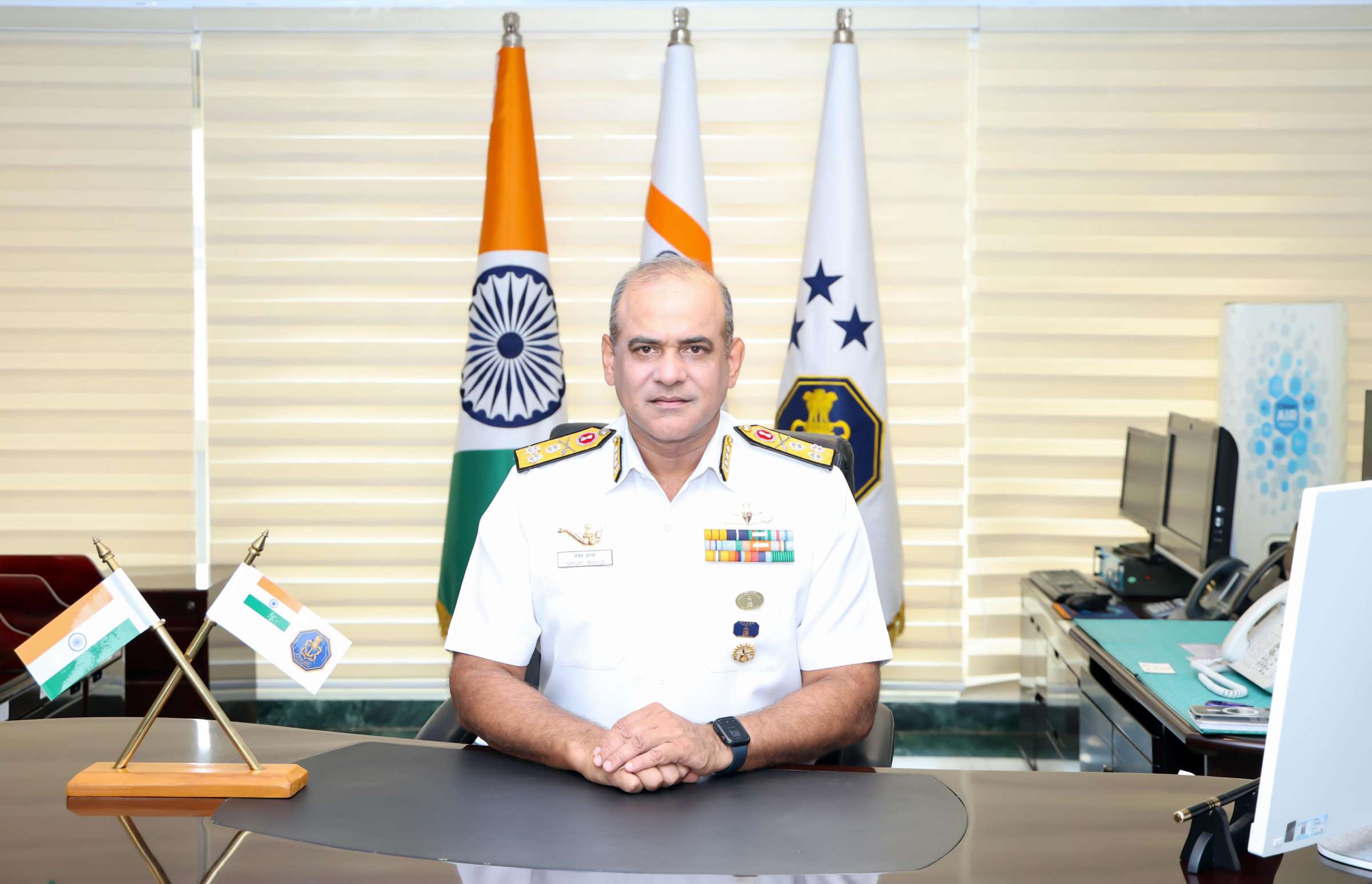
In an exclusive interview to Vizag Industrial Scan, the flag officer commanding in chief of the Eastern Naval Command, Vice Admiral Sanjay Bhalla, AVSM, NM spoke on the coveted role of the Indian Navy, the importance of Vizag Naval Trifecta, its economic impact on the city and India’s growing prowess in defence shipbuilding.
If you could briefly talk us through the significance of the Eastern Naval Command and its overall mandate in the Indian Navy.
The Eastern Naval Command is the Indian Navy’s principal operational command on the eastern seaboard and the fulcrum of our engagement in the Bay of Bengal and the wider Indo-Pacific.
Its mandate spans deterrence, maritime security, humanitarian assistance, and sustained engagement with partner navies making it central to India’s role as a Preferred Security Partner in the region.
The Indian Navy is hosting IFR, MILAN and IONS — often called the Vizag Naval Trifecta 2026. Could you explain the importance of each and the value they create?
Each of the three events; IFR, MILAN, and IONS, plays a distinct but reinforcing role in advancing maritime partnerships. The International Fleet Review (IFR) celebrates naval camaraderie and transparency through time-honoured maritime traditions.
MILAN strengthens operational collaboration and interoperability through sea-phase exercises and shore-based interactions.
The IONS Conclave of Chiefs fosters strategic-level dialogue, intellectual capital and multilateral cooperation among Indian Ocean Region navies on shared challenges and opportunities.
Together, this ‘Vizag Naval Trifecta’ exemplifies India’s growing ability to convene, collaborate, and contribute to regional and global maritime security.
It reflects our commitment to building bridges of camaraderie, advancing practical cooperation, and promoting collective responsibility for a free, open, and secure Indo-Pacific.
Q3. Executing three mega events in a single week at one location is challenging. How does the Navy prepare for such an endeavour and how does it affect the city?
Hosting IFR, MILAN, and the IONS Conclave in one week and one city is a complex endeavour. The Indian Navy has prepared through phased planning, inter-agency coordination, and layered rehearsals.
A ‘whole of Navy’ and ‘whole of government’ approach underpins this effort, with exceptional support from the Government of Andhra Pradesh and the Visakhapatnam District Administration.
These events have significantly transformed Visakhapatnam. Since IFR 2016, they have catalysed civic upgrades – roads, coastal lighting, smart infrastructure, and beautification.
The city has delivered on tight timelines, using these events as hard deadlines to accelerate key urban projects in the city including work on national highways and other public infrastructure.
As you may be aware, this year alone GVMC is spending Rs 19 Cr for various upgrade works in the city.
Economically, these events generate peak-season footfall across hotels, transport, and local businesses. International City Parade and public displays attract lakhs of people, while city-wide enhancements boost tourism potential year-round.
Museums like INS Kursura and TU-142M have become permanent public legacies of this naval-city partnership.
In summary, preparation for the Naval Trifecta is not just about operational excellence—it is about civic progress, economic vibrancy, and Visakhapatnam’s rise as a strategic maritime hub.
The Navy is proud to work alongside the people and leadership of this City of Destiny.
How does the Indian Navy and ENC view maritime security in India’s economic growth story, especially in the Indo-Pacific?
Maritime Security is central to India’s economic journey. With over 90% of our trade by volume and the majority share of energy imports moving by sea, the safety of our maritime commons is vital.
India’s rise as a $5 trillion economy hinges on secure, open oceans, and hence maritime security which the Indian Navy ensures anytime, anywhere and anyhow.
In the Indo-Pacific, where strategic rivalry meets economic interdependence, the Navy’s role cannot be overstated.
The Eastern Naval Command, the operational arm on the eastern seaboard ensures sustained presence, surveillance, and deterrence from the Bay of Bengal to the Malacca Strait and beyond.
We safeguard sea lanes, ensure open and free oceans, and counter grey-zone threats.
Through mechanisms like IPOI, IONS, and MILAN, the Navy fosters interoperability, trust, and shared maritime awareness.
These partnerships enable quicker responses, protect undersea infrastructure and support global commerce key to investor confidence and economic resilience.
As India integrates deeper into global value chains across semiconductors, energy, rare earths, and green shipping, maritime security becomes existential.
The Eastern Naval Command at the helm in the eastern theatre, remains both a shield and catalyst in India’s Indo-Pacific growth story.
What opportunities and challenges do you see for Indian shipyards in the context of IFR and growing global demand for ships?
Indian shipyards today stand at a unique inflection point. With global demand for both naval and commercial vessels rising, driven by supply chain diversification, maritime security concerns, and fleet renewal cycles, our shipbuilding industry is well-positioned to capitalise on this opportunity.
We have indigenous strengths in design, modular construction, and life cycle sustainment, demonstrated through platforms like the P-17A frigates, Kamorta class corvettes, OPVs, and aircraft carriers.
Events like the IFR serve as live showcases of India’s naval industrial capabilities to a global audience.
Visiting delegations and foreign navies gain first hand exposure to Indian-built warships, shipyard infrastructure, and the Navy’s self-reliance drive.
This visibility enhances our soft power and opens strategic and export partnerships.
In sum, IFR 2026 is not just a ceremonial review, it is a strategic opportunity to position Indian shipbuilding as a credible partner in the global maritime ecosystem.
The Navy, for its part, continues to prioritise indigenisation, fleet readiness, and industry collaboration under the Make in India and Atma Nirbhar Bharat frameworks.
How does the Indian Navy plan to leverage IFR to promote Make in India and indigenous shipbuilding?
Indian shipyards are witnessing a transformative phase, with over 40 naval vessels currently under construction, including marquee projects like P-17A frigates, ASW Shallow Water crafts, Multi-Purpose Vessels and Fleet Support Ships.
Recent government approvals underscore the Navy’s full commitment to domestic procurement. Backed by 68% capital outlay earmarked for indigenous platforms, and a strong push for green and digital shipyards, India is also expanding defence exports.
IFR 2026 offers a strategic opportunity to showcase these capabilities to over 70 international navies.
IFR 2026 will showcase state of the art indigenously built aircraft carrier INS Vikrant, Nilgiri class of frigates and Visakhapatnam class destroyers.
IFR provides a powerful platform to showcase India’s indigenous warships, systems, and shipbuilding ecosystem to a global audience.
By displaying operationally proven platforms and interacting with partner navies, we reinforce confidence in India’s manufacturing capability under the Make in India and Atma Nirbhar Bharat initiatives.
How does IFR contribute to India’s maritime diplomacy and regional security efforts?
The International Fleet Review (IFR) is a flagship event of India’s maritime diplomacy, blending ceremonial grandeur with strategic purpose.
It enables India to exercise convening power at scale, bringing together over 70 foreign navies in a non-coercive setting that fosters trust, transparency, and professional dialogue.
By transforming a traditional naval review into a concentrated forum of engagement, IFR amplifies India’s role as a responsible maritime partner in the Indo-Pacific.
As India aligns its maritime vision under frameworks like SAGAR, IPOI, and the MAHASAGAR initiative, IFR serves as a symbolic expression of these values.
It reassures regional partners, projects India’s naval indigenisation journey, and highlights our ability to harmonise capability with cooperation.
In this sense, IFR is not merely ceremonial; it is a multiplier of diplomatic bandwidth, showcasing India’s commitment to maritime stability, openness, and rule-based order in the Indo-Pacific region.
What would you say are the top five takeaways for the Indian Navy from these events?
First, enhanced trust and familiarity among partner navies. Second, improved interoperability and professional exchange.
Third, strengthened maritime diplomacy and strategic dialogue. Fourth, strategic signalling of India’s naval capabilities and defence industry.
And finally, reaffirmation of India’s role as a responsible maritime power and Preferred Security Partner in the Indo-Pacific Region.
With three major international events in the City of Destiny, what economic impact do you foresee for the city and the state?
Hosting IFR, MILAN, and the IONS Conclave together have created a remarkable economic surge across Visakhapatnam and Andhra Pradesh.
These events bring thousands of delegates, sailors, media personnel, and tourists which directly benefits sectors like hospitality, transportation, retail, and local crafts.
Hotels, restaurants, logistics providers, and MSMEs experience a surge in demand akin to an extended tourist season.
However, the impact is not just short-term. These high-visibility events significantly elevate Visakhapatnam’s global stature as a maritime and investment-friendly city.
Past events like IFR 2016 catalyzed civic upgrades, coastal beautification, road infrastructure, and disaster-resilience planning; all of which became long-term assets for the city.
The current trifecta builds on that legacy, reinforcing the city’s identity as India’s Eastern maritime gateway.
In strategic terms, this momentum strengthens the case for greater infrastructure investments, blue economy initiatives, and port-led industrial growth in Andhra Pradesh.
Events of this scale create a lasting narrative – of Visakhapatnam as a city capable of hosting global forums, attracting international attention, and anchoring India’s Indo-Pacific outreach.
MILAN has evolved from four navies to a large congregation today. What has driven this rise?
EX MILAN’s transformation from a modest gathering of four navies – India, Indonesia, Singapore, and Thailand in 1995 into one of the Indo-Pacific’s most significant naval engagements reflects India’s growing maritime stature and its consistent commitment to regional cooperation.
Originally conceived as a confidence-building initiative in Port Blair (now Sri Vijayapuram), MILAN emphasized trust through basic search and rescue and communication drills.
Over the decades, it has matured into a platform blending operational interoperability with diplomatic outreach.
The introduction of complex sea-phase operations, especially since MILAN 2018 when the MILAN Exercises at Sea (MILES) was formalised, expanded the exercise’s scope to include advanced naval warfare drills, anti-submarine tactics, and replenishment operations.
The relocation of MILAN to Visakhapatnam in 2022 was a strategic shift. It signalled India’s readiness to elevate the exercise to a continental scale, leveraging the capabilities of the Eastern Naval Command and transforming the eastern seaboard into a true Indo-Pacific gateway.
Participation has since surged, from 14 nations in 2012 to 47 in 2024, underscoring global trust in India’s intent and operational credibility.
EXMILAN’s inclusive and non-aligned ethos, its alignment with SAGAR and Act East, and now MAHASAGAR and its relevance to contemporary maritime challenges have made it very relevant today.
It is no longer just a naval drill, it is India’s maritime strategy in action, where camaraderie, collaboration, and cohesion are not only themes, but practice.
A total of 74 nations including 20 foreign warships and 3 foreign aircraft will be participating in IFR and Milan 2026.
What are the Indian Navy’s key focus areas over the next 5–10 years, especially in maritime security and shipbuilding?
Our priorities include strengthening maritime domain awareness, enhancing undersea and air capabilities, expanding indigenous shipbuilding, and integrating emerging technologies such as AI and autonomous systems.
These efforts ensure readiness for both traditional and non-traditional maritime challenges.
How important is the role of MSMEs in supporting the Eastern Naval Command?
MSMEs are vital partners in our logistics, maintenance, and manufacturing ecosystem. They bring agility, innovation, and depth to the supply chain, enabling faster turnaround and greater self-reliance.
The Eastern Naval Command has consistently met and exceeded mandated procurement targets from MSMEs over the last two financial years.

