
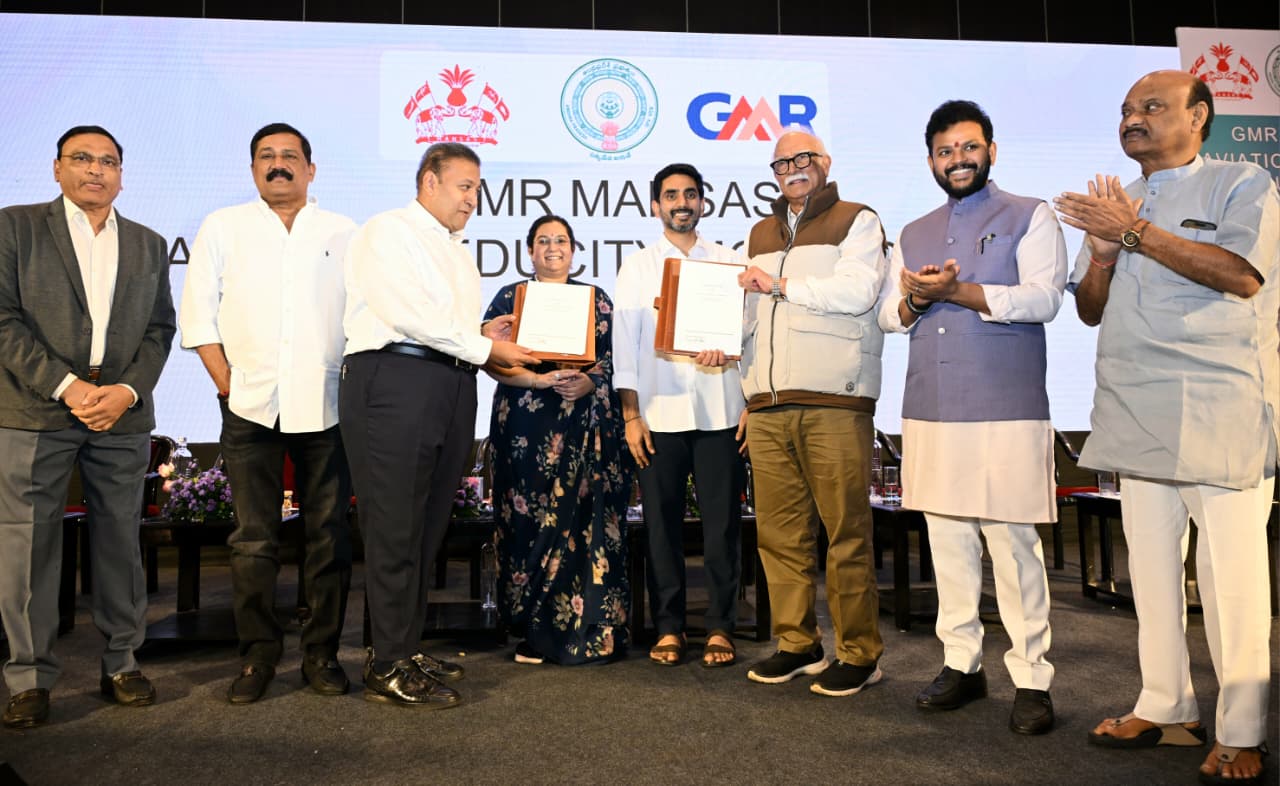
GMR–MANSAS Aviation EduCity to Address Global Aviation Skill Shortage, Build India’s Next-Generation Aviation Workforce
In a major step aligned with India’s rapidly expanding civil aviation and aerospace ecosystem, the Government of Andhra Pradesh today announced the launch of India’s first integrated Aviation, Aerospace and Defence (AAD) EduCity near the upcoming Bhogapuram International Airport.
As per an official release from the state government the GMR–MANSAS Aviation EduCity, spread over about 136 acres, is designed as a national capability platform to address the acute global and domestic shortage of aviation professionals and to position India as a leading supplier of aviation talent.
AP’s Education and IT Minister Mr Nara Lokesh, who presided over the signing of a Memorandum of Understanding between GMR Group and the MANSAS Trust at Visakhapatnam, said the initiative responds directly to the most pressing constraint facing the aviation sector today: human capital.
“India’s aviation story is one of scale and speed, but the real bottleneck is skilled manpower. The GMR–MANSAS Aviation EduCity is our response to that challenge—creating a world-class ecosystem that integrates education, research, industry, and on-the-job training,” he said.
How this Helps
India’s aviation sector is among the fastest-growing globally. Passenger traffic is projected to reach 700 million annually across 200 airports, while the country’s commercial aircraft fleet is expected to double to nearly 1,700 aircraft by 2030.
Parallelly, India’s aerospace and defence market is projected to grow from $28.7 billion in 2024 to $57 billion by 2034.
However, this growth has exposed a widening skills deficit. Industry estimates point to shortages of 12–15% in qualified pilots, aircraft maintenance engineers (AMEs), air traffic controllers, safety specialists and airport operations professionals.
Despite the scale of demand, India currently produces only about 8,000 aerospace engineers annually—less than 0.5% of total engineering graduates.
Against this backdrop, the Bhogapuram EduCity aims to serve as a long-term national solution, not merely a training facility.
A First-of-Its-Kind Integrated Model
Unlike standalone universities or training academies, the GMR–MANSAS Aviation EduCity is being conceptualised as a fully integrated education–innovation–industry cluster, combining:
* International branch campuses (IBCs) and globally reputed universities
* Licensing and certification programmes aligned with DGCA, EASA and global standards
* Advanced research and innovation centres in aerospace design, AI-enabled aviation systems, UAVs, sustainable aviation and safety
* Incubation, prototyping and startup support for aviation and aerospace technologies
* Residential and social infrastructure, creating a self-sustaining campus ecosystem
This model aligns with National Civil Aviation Policy (NCAP), NEP 2020, Make in India, and India’s broader aerospace and defence ambitions.
Strategic Advantage of Bhogapuram
The location near Bhogapuram International Airport provides a decisive edge. Airport adjacency allows real-time on-the-job training (OJT), live testing environments, and seamless industry immersion—mirroring globally successful models such as Dubai International Academic City, Research Triangle Park (USA) and Aerospace Valley (France) , said the release.
Officials noted that global experience shows such agglomeration effects—where universities, OEMs, suppliers, labs and talent co-locate—deliver outsized gains in productivity, exports and regional GDP.
Vision: From India to the World
Minister Nara Lokesh said the state’s vision is to ensure that at least 25% of the global civil aviation workforce is Telugu, while contributing decisively to India’s talent requirements.
“This is not about creating another university. It is about building an ecosystem that supplies job-ready professionals, cutting-edge research and globally benchmarked skills,” he said.
EduCity will offer a full talent pipeline—from AME, ATC and airport operations programmes to advanced specialisations in aerospace dynamics, sustainable aviation fuels, AI and cybersecurity in aviation, UAV systems and advanced air mobility.
Industry-Led, Research-Driven
The project draws inspiration from global benchmarks such as Aéro Montréal (Canada), Washington–Seattle Aerospace Cluster (USA) and Aerospace Valley (France), where integrated ecosystems have translated talent and research into global competitiveness.
Officials said the EduCity will operate through a mix of plug-and-play academic infrastructure and build-to-suit campuses, enabling rapid entry for foreign universities and industry partners.
Public Purpose and Philanthropic Support
The release added that the land for the EduCity has been made available by the MANSAS Trust, reflecting a rare instance of large-scale philanthropic support for public education infrastructure.
Minister Lokesh acknowledged the contribution of Governor of Goa and MANSAS Trust Chairman Mr P. Ashok Gajapathi Raju and Vizianagaram MLA Ms. Aditi Gajapathi Raju, calling it “a contribution that will shape India’s aviation future for decades.”
Timeline and Outlook
The Andhra Pradesh government has committed to developing the core EduCity infrastructure within 12 months, with phased onboarding of global academic and industry partners thereafter.
“With aviation demand exploding worldwide, countries that invest early in talent ecosystems will lead the next phase of growth. Through the GMR–MANSAS Aviation EduCity, Andhra Pradesh is positioning India not just as a large aviation market, but as a global supplier of aviation talent and innovation,” the Minister said.
The launch event was attended by Union Civil Aviation Minister Mr K. Ram Mohan Naidu, AP Assembly Speaker Mr Chintakayala Ayyannapatrudu, GMR Airports Chairman Mr G.B.S. Raju, senior state leaders, and industry representatives.

